
Table of Contents
-
-
- 1. AI Agents Boost Efficiency, but Bring New Attacks
- 2. Traditional SOC Can No Longer Keep Up with the Speed of AI Agents
- 3. What Is AI SOC, and Why Is It the Direction of Next-Generation SOC?
- 4. How SOC724.ai Drives Security Operations with AI Agents
- 5. 3 Key Evaluation Points for Adopting an AI Agent-Driven SOC
-
Over the past two years, AI Agents have become real working tools inside enterprises, answering customer inquiries, analyzing financial data, and executing cross-departmental processes by connecting to internal systems. An AI Agent is no longer just a chatbot. It’s a digital worker that plans autonomously, calls external tools, and carries out tasks on its own.
That’s an efficiency win for CIOs and CTOs. For CISOs and security teams, it raises a harder question: once an Agent starts accessing sensitive data and triggering business processes on behalf of humans, where does the security boundary sit? Existing SOC architectures were built to monitor people and devices, not AI behavior.
This article looks at the new security challenges AI Agents introduce, why SOC architecture needs to evolve, and how a next-generation, AI Agent-driven SOC lets enterprises capture AI’s efficiency gains without losing the protection they need.
1. AI Agents Boost Efficiency, but Bring New Attacks
Agent autonomy breaks traditional security rules. Traditional security defenses were designed around “people” as the subject. Access control, behavioral baselines, and anomaly detection rules were all built to model employee accounts with fixed work hours and predictable habits.
The rise of AI Agents breaks this assumption.
An AI Agent deployed inside an enterprise might automatically read from a CRM database overnight, write a sales analysis report, and push the result to a Slack channel via API. Functionally, none of this is anything but legitimate, and it won’t trigger traditional anomaly alerts, because it’s exactly what the Agent was designed to do.
But once an Agent’s instructions are tampered with (a prompt injection attack, where an attacker embeds malicious instructions in the input to make the Agent perform unintended actions), or once an Agent’s API key is stolen, that same behavior can become a channel for data exfiltration, and existing rule-based detection systems have no way to distinguish normal activity from malicious activity.
1-1. The Boundary of Enterprise Data Flow Is Disappearing
In the past, security teams could define fairly clearly where data lived and who accessed it. But as AI Agents start crossing different systems, calling external APIs, and accessing cloud services, the boundary of enterprise data flow becomes difficult to track. A single Agent might hold access credentials for multiple systems at once, with its operations spanning on-premises and cloud environments, and every call can leave behind traces of sensitive data.
This isn’t a hypothetical risk. According to a list of AI Agent security threats published by the security research organization OWASP, prompt injection and credential abuse are ranked among the highest-priority risks for enterprises deploying AI Agents, and traditional network perimeter defenses offer almost no protection against them.
2. Traditional SOC Can No Longer Keep Up with the Speed of AI Agents
Enterprise SOC teams have long faced a structural problem: the volume of security alerts generated daily far exceeds what analysts can manually process.
Once AI Agents are deployed at scale, this problem gets worse. Every API call, every data access, every cross-system operation by every Agent leaves a trace in logging systems at various layers. When an enterprise runs dozens of Agents at once, the daily volume of behavioral logs grows exponentially. At this scale, manual analysis is no longer just an efficiency problem, it’s a physical impossibility.
According to Gartner’s 2025 survey on AI applications in security, 42% of security leaders said their organizations are already piloting or formally using AI Agents for threat detection and response, and another 46% plan to adopt them within the next year. This tells us one thing: AI Agents entering the SOC is now an industry direction, not an option.
2-1. Agent Behavior Differs from Traditional Threat Signatures, Rule-Based Detection Falls Short
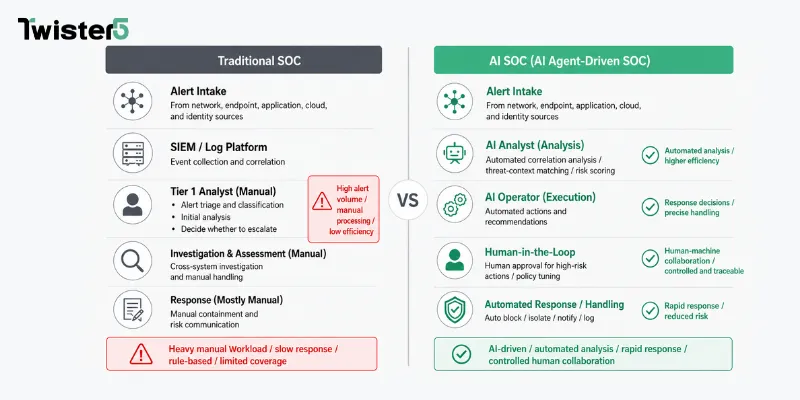
The detection logic of a traditional SOC is built on known attack signatures: malicious IPs, unusual login times, known malware. This logic works reasonably well against human attackers, because their behavior patterns tend to differ in recognizable ways from normal users.
AI Agent behavior is fundamentally different.
Agents operate faster than humans, more frequently than humans, and across a broader range of systems than a single employee ever would. When an attacker manipulates an Agent to launch an attack, or when an Agent itself performs an unauthorized action due to a misconfiguration, these anomalies often don’t match any existing alert rule signature. They’re only discovered later during log audits, by which point the damage has usually already been done.
Static SOAR (Security Orchestration, Automation, and Response) scripts face the same challenge. Once a rule is written, it struggles to keep pace with Agent behavior that keeps evolving. What SOC teams need isn’t more rules, it’s intelligent analysis capable of understanding Agent behavior logic and interpreting anomalies in real time.
3. What Is AI SOC, and Why Is It the Direction of Next-Generation SOC?
In a traditional SOC’s tiered structure, Tier 1 analysts handle front-line alerts: triaging, initial classification, deciding whether an issue needs to be escalated. This role is highly repetitive, extremely high pressure, and has the highest turnover rate of any SOC position.
The core idea behind Agentic SOC (a security operations center driven by AI Agents) is to have AI Agents take over Tier 1 analysis work entirely. When an alert enters the system, the AI Agent automatically runs through the following process: gathering related intelligence from multiple sources, cross-referencing threat databases, assessing severity, producing a preliminary assessment, and recommending whether to close the alert, block it automatically, or escalate it to a human analyst.
This isn’t “AI replacing humans,” it’s a restructuring of responsibilities where “AI leads monitoring and analysis and provides recommendations and instructions, while humans make the final call and authorize AI to act.” For SOC teams, this means analysts can shift their time away from alert triage toward threat hunting, root cause analysis, and security collaboration with business units, the work that genuinely requires human expertise.
3-1. How Human-in-the-Loop Keeps AI SOC Controllable
The most common concern enterprises raise when adopting Agentic SOC is: who’s responsible when the AI makes a wrong call? The answer to this question determines whether an AI SOC architecture can actually be trusted.
A mature Agentic SOC architecture answers this with Human-in-the-Loop, a human-AI collaborative decision mechanism. Before executing any high-risk action, such as blocking an IP, isolating an endpoint, or revoking user privileges, the AI Agent must be reviewed and confirmed by a human analyst rather than executing automatically. AI is responsible for quickly providing the basis for judgment, while humans are responsible for making the final authorization decision.
This mechanism delivers two key benefits: it ensures high-impact decisions always retain human accountability, and it keeps AI’s judgments under continuous human validation, forming a feedback learning loop. The goal of AI SOC isn’t to replace security analysts, it’s to free analysts from the pressure of processing volume so they can focus on the quality of judgment.
4. How SOC724.ai Drives Security Operations with AI Agents
SOC724.ai is Twister5’s service brand focused on AI-driven security operations, powered by AI Workforce (AIW), the core engine of the ACROSS platform. Rather than a single AI model handling everything, its architecture is built on a team of three Agent roles with clearly defined responsibilities.
AI Analyst handles continuous monitoring and analysis at the data layer, extracting anomalous signals from cross-system logs, network traffic, and endpoint behavior. This corresponds to the Tier 1 alert triage work of a traditional SOC, but at a speed and scale far beyond manual processing capacity.
AI Operator handles the process execution layer. Once AI Analyst completes its assessment and confirms a response is needed, AI Operator executes the corresponding action according to predefined security workflows, blocking a malicious source, triggering isolation procedures, logging the response, and submitting any high-risk action to a human analyst for review before it executes.
AI Assistant plays a decision-support role, providing human analysts with incident context summaries, attack path reconstruction, and response recommendations, so analysts can quickly grasp the full picture when making a final decision rather than piecing it together from fragmented information.
The core logic of this three-layer architecture is separation of duties: analysis, execution, and support each have a dedicated Agent responsible for it, while humans retain final control over key decisions.
4-1. From Threat Detection to Automated Response: How SOC724.ai Actually Works
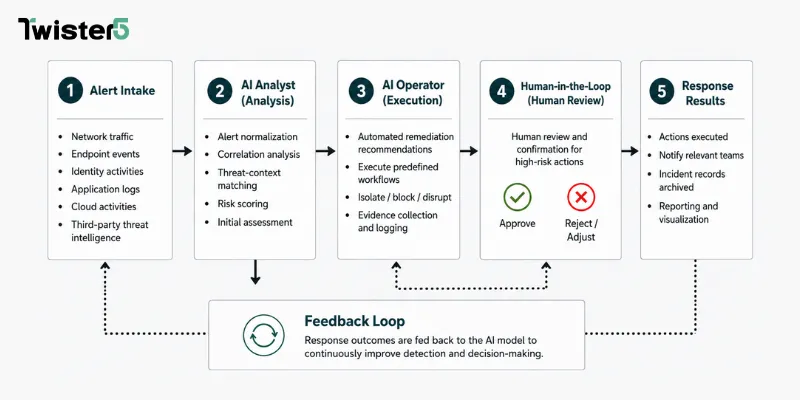
Once an enterprise deploys SOC724.ai, a complete security incident handling process looks like this:
When an alert enters the system, AI Analyst completes an initial analysis within minutes, cross-referencing threat intelligence databases and assessing severity. Low-risk alerts are archived directly by the system, while medium and high-risk incidents move into AI Operator’s response workflow, automatically executing a first layer of response and notifying human analysts in parallel. Actions with a high potential impact, such as large-scale blocking or account suspension, require human confirmation before execution, ensuring the Human-in-the-Loop mechanism is enforced at every critical checkpoint.
This entire process runs within ACROSS’s AI Security (AIS) module, whose underlying architecture spans a protection layer, data lake, inference layer, and analysis layer, using the Cyber LLM to connect alert semantics, attack vector characteristics, and historical response records into structured knowledge that Agents can reason over.
4-2. Integrating a Defense Ecosystem with Cloudflare, Cato Networks, CrowdStrike, and F5
SOC724.ai isn’t a standalone black box, it’s built on top of Twister5’s years of deep partnership with leading international security vendors.
Cloudflare provides network-layer DDoS protection and traffic scrubbing. Cato Networks’ SASE architecture unifies management of an enterprise’s distributed network and security policies. CrowdStrike’s endpoint detection and response (EDR) technology strengthens device-layer threat visibility. F5 handles application-layer traffic management and API security. Security signals from these partners all flow into SOC724.ai’s analysis layer, where AI Agents integrate and assess them across platforms rather than working in isolation.
For enterprises, this means adopting AI SOC doesn’t require giving up existing security investments. SOC724.ai is designed to integrate with existing protection capabilities, not replace them.
5. 3 Key Evaluation Points for Adopting an AI Agent-Driven SOC
When enterprises begin evaluating Agentic SOC solutions, beyond technical capability, there are three dimensions worth clarifying before making a purchasing decision.
5-1. Data Sovereignty and Deployment Flexibility
AI SOC operations rely heavily on an enterprise’s internal logs and event data. This data often involves access records for the most sensitive business systems, and once it’s sent to an offshore cloud platform for processing, it faces data sovereignty and regulatory compliance risk. For regulated industries such as finance, healthcare, and government, this isn’t a matter of technical preference, it’s a hard constraint.
When evaluating a solution, confirm whether the vendor supports on-premises deployment or a hybrid cloud architecture, so AI inference can run within the enterprise’s own environment without data ever being transmitted to a third-party platform.
5-2. Integration with Existing Security Investments
Enterprises’ accumulated investment in security tools typically spans multiple layers, including SIEM, firewalls, and endpoint protection. An AI SOC that requires a complete overhaul of existing architecture to function, no matter how powerful, is difficult for an organization to justify given the adoption cost and risk.
In practice, confirm whether the AI SOC solution can integrate with existing security tools through standard APIs and bring cross-platform signals into a unified analysis layer. The depth of integration determines the scope of attack surface visible to the AI Agent: the more complete the integration, the fewer the blind spots.
5-3. Visibility and Accountability Mechanisms
What did the AI do, why did it reach that conclusion, and who authorized which action? These questions carry as much weight as technical capability in security audits and regulatory compliance.
When choosing an AI SOC solution, require the vendor to provide a complete decision log and behavioral audit trail, ensuring every action taken by every AI Agent is traceable, explainable, and accountable. An AI SOC without visibility can become a gray area of accountability exactly when something goes wrong.
AI Agents are evolving from efficiency tools into a digital workforce for the enterprise. As Agents begin accessing systems, executing processes, and making judgments on behalf of humans, security teams are no longer just facing external attackers, they’re also facing a governance challenge that comes from the behavior of internal AI itself.
Traditional SOC architecture was never designed with this scenario in mind. Agentic SOC exists precisely to fill that gap: letting AI protect against AI, in the form of an Agent, so the speed and intelligence of security defense can truly match the pace of threats in the AI era.
Twister5, built on a foundation of cybersecurity, delivers AI Agent-driven security operations capability to enterprises through SOC724.ai, helping organizations build a protection architecture that matches the efficiency they gain from AI.
Ready to evaluate the right Agentic SOC architecture for your organization?
👉 Contact Twister5 team now to start an AI SOC architecture assessment, or learn more about SOC724.ai.