
Table of Contents
“Enterprises don’t lack tools. What they lack is a single gateway where every use of AI by employees can be seen and managed.”
At CYBERSEC 2026, the most common thing we heard wasn’t “is AI useful,” it was:
“We don’t know how to manage it.”
The problem isn’t a lack of tools, it’s too many of them. Different departments each subscribe to their own models, put API costs on personal credit cards, and send data straight to the cloud, with IT or leadership always finding out last.
The real question has never been whether AI works. It’s:
- Who is using it?
- What data is being used?
- How many Tokens have been spent?
- Who’s accountable when something goes wrong?
When employees drop customer lists, unreleased financial statements, or intellectual property into a chat window just to move faster, it looks like a productivity gain on the surface. But underneath, it plants financial and compliance risks like Shadow AI and runaway Token costs. Without clear usage policies and technical safeguards, the competitive edge an enterprise quietly loses can turn into a full-blown operational crisis.
This is exactly why Twister5 built ACROSS.
1. What Is an Enterprise AI System? Positioning ACROSS
ACROSS isn’t another AI tool. It’s an enterprise’s “AI governance gateway.”
At the hardware layer, ACROSS combines with Phison’s aiDAPTIV+ technology to deliver cost-effective on-premises inference compute, ensuring core confidential data is processed internally and true data sovereignty is achieved. At the software layer, ACROSS is built around AIW (AI Workforce) as its core engine, helping enterprises build fully sovereign digital AI capabilities.
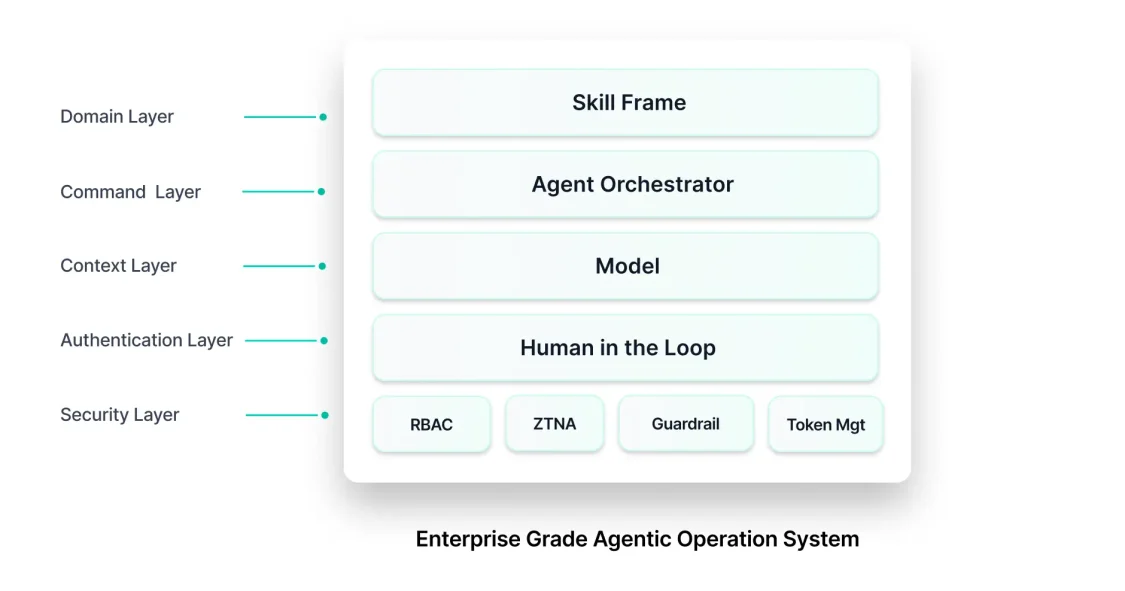
2. 3 Core Capabilities of Enterprise AI Governance
To address the pain points of Shadow AI and uncontrolled AI risk, ACROSS distills complex security engineering into the three core management capabilities enterprises need most, making compliance and control a standard part of operations.
2-1. Identity and Access Control
What does enterprise-grade AI identity control look like? ACROSS deeply integrates GoTrust’s passwordless authentication technology, combining Zero Trust Access with identity verification at every single model call. Whether it’s a human employee or an underlying AI Agent, Role-Based Access Control (RBAC) is enforced at every step, preventing unauthorized access at the source.
2-2. Cost Visibility and Behavior Management
Finance and audit leaders no longer have to face black-box API bills. ACROSS keeps a full operational trail of every model call in the background, and its built-in multi-layer Guardrails automatically block and filter abnormal behavior that violates regulations or internal policy at the moment of transmission, turning hidden financial exposure and security risk into fully visible, auditable operational metrics. The dashboard gives real-time visibility into each department’s Token consumption, and Twister5 also offers consolidated billing services to integrate enterprise procurement processes, solving the chaos of employees expensing AI costs on personal cards.
2-3. Human-AI Collaborative Review Process
Enterprises need to empower their teams, not hand over blind authority. To prevent AI automation from running out of control, ACROSS builds Human-in-the-Loop (HITL) and Harness Engineering directly into its technical core. The system can be configured with human review checkpoints, triggering HITL whenever a security event occurs, ensuring important decisions still go through human judgment.
3. 3 Modules Building an Enterprise AI Protection Network
Built on the AIW core engine and the three core capabilities above, ACROSS layers three management modules to extend governance and defense across different business scenarios.
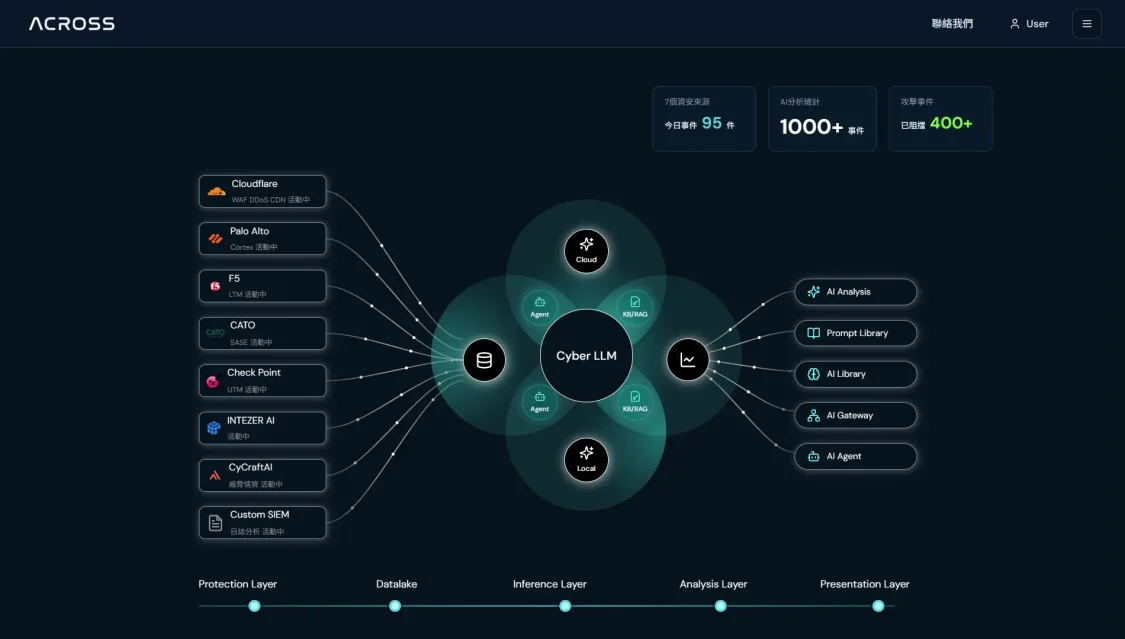
Enterprises have typically already invested heavily in brands like Cato Networks, Cloudflare, F5, or CrowdStrike. ACROSS’s AIS module doesn’t replace these defenses, it consolidates event logs and data from these security brands into a single ACROSS interface. Through the Cyber LLM engine, security teams get automated threat analysis, letting them monitor the protection status of every security brand directly within the ACROSS interface, detecting proactively and responding in real time.
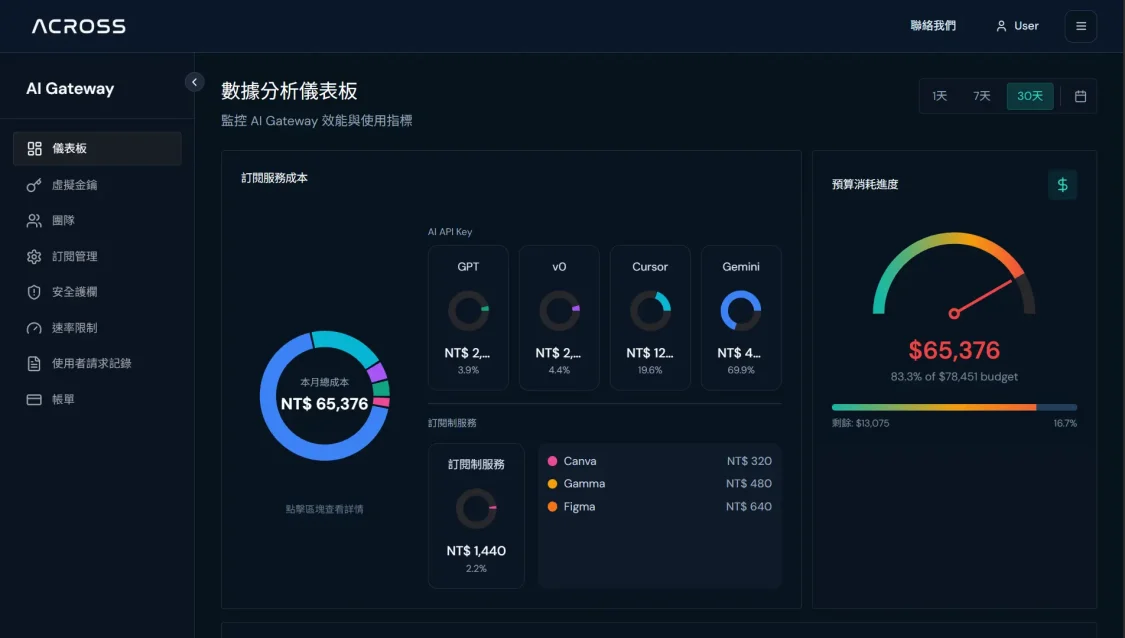
The AIG module brings scattered departmental subscriptions under a single gateway and establishes organizational policy. It effectively solves the problem of unclear AI usage, helps IT departments understand the actual state of model usage, and brings AI applications fully back within enterprise risk control, ensuring security, compliance, and accountability. It includes four core capabilities:
- RBAC access control: The system provides fine-grained permission control. Every model call by a human employee or an underlying AI Agent is governed, preventing unauthorized access at the source.
- Multi-layer Guardrails: Proactive defense runs in the background. At the moment data is transmitted, the system automatically filters and blocks abnormal behavior that violates internal policy, keeping generative AI use secure.
- Token usage visibility: The dashboard provides real-time monitoring, letting audit and finance leaders track each department’s consumption instantly, turning hidden financial exposure into a fully visible, auditable operational metric.
- Consolidated billing: A one-stop procurement integration service. A single gateway consolidates scattered tool subscriptions, solving the chaos of employees expensing costs on personal cards, and letting enterprises deploy AI safely in a controlled environment.
3-3. AIE (AI Ecosystem): Connecting Domain Experts
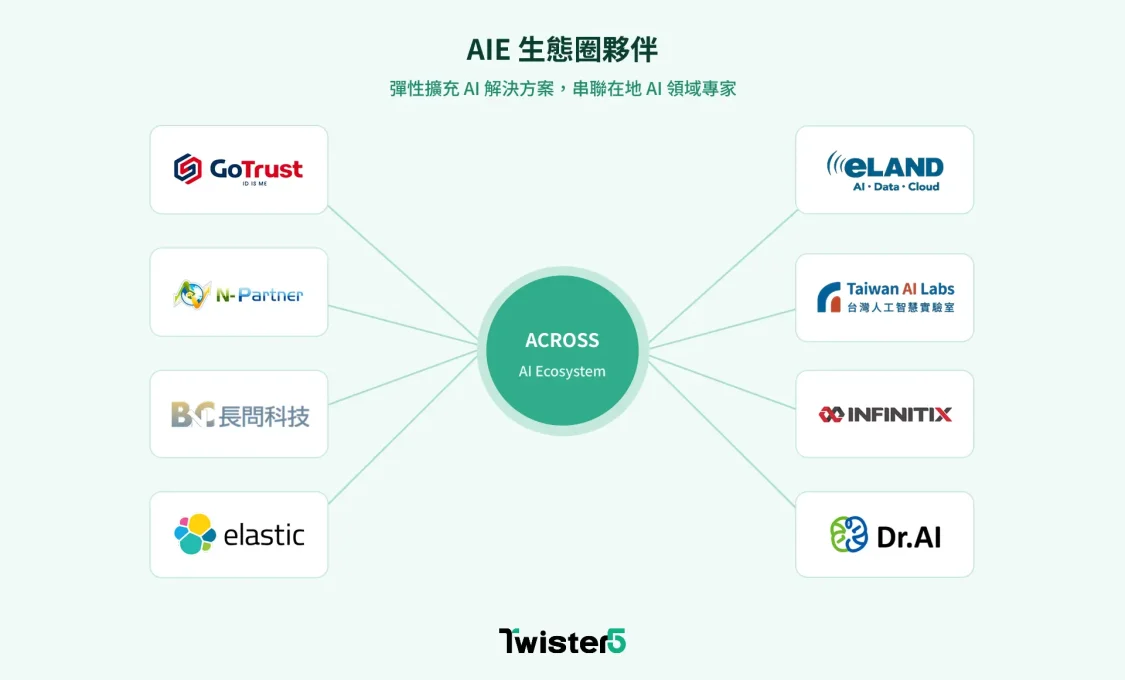
The ACROSS AIE module features an open ecosystem integration capability. The system connects with eLAND’s AI big data and semantic analysis, Ainergy Technology’s speech recognition, and local domain experts including Taiwan AI Labs, INFINITIX, and Dr.AI. Enterprises can flexibly extend different AI solutions based on their needs, meeting diverse business requirements.
4. 3 Real-World Scenarios: How ACROSS Works in the Enterprise
How does ACROSS translate technology into real operational value? Let’s look at three everyday business scenarios.
4-1. Scenario 1: SOC Automated Coordinated Defense
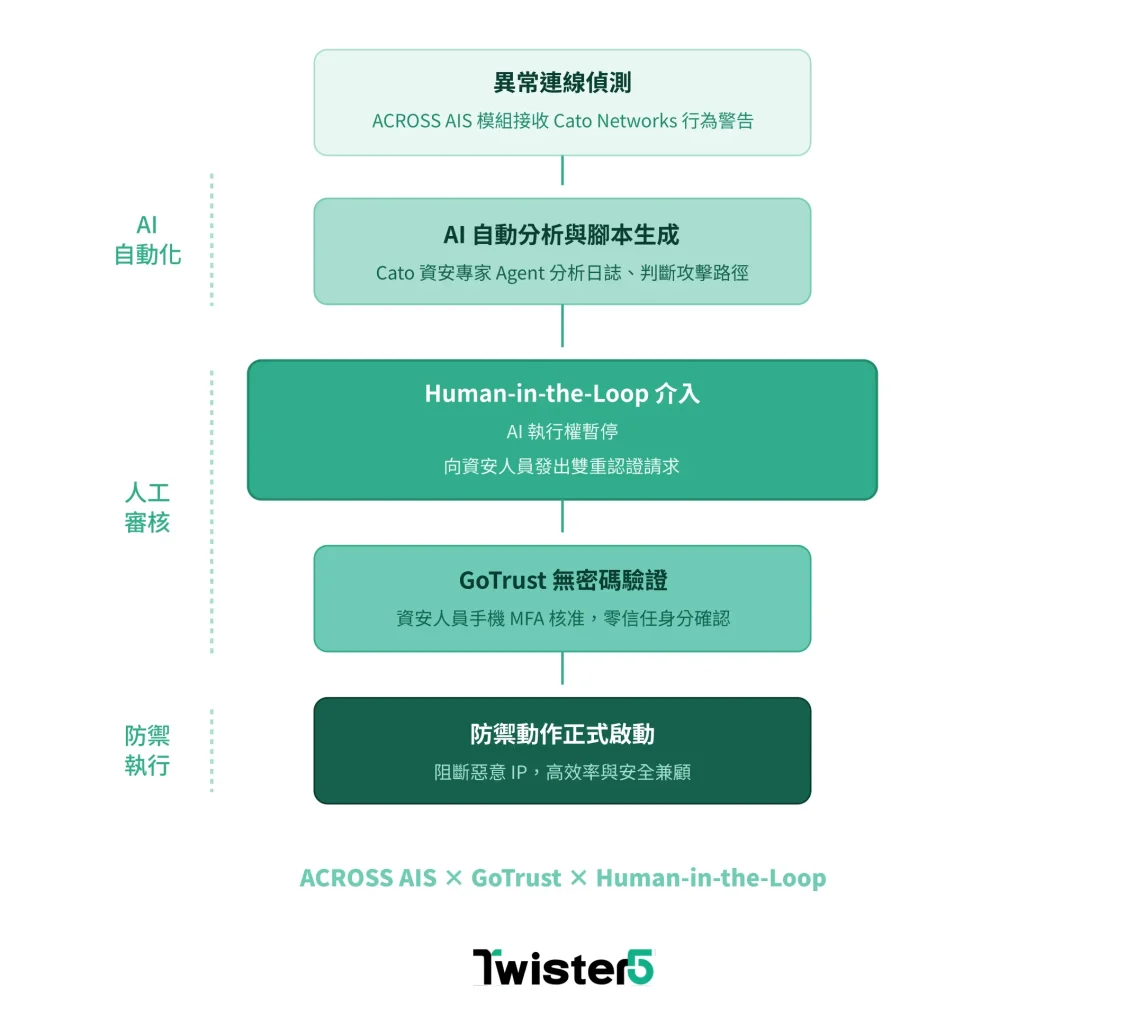
The system detects an abnormal connection, and ACROSS’s AIS module receives a behavioral alert from the integrated Cato Networks feed. ACROSS’s built-in security agent quickly analyzes a large volume of event logs, identifies the attack path, and automatically generates a script in the background to block the malicious IP. At this point, the Human-in-the-Loop (HITL) mechanism steps in, pausing the AI’s execution authority and sending a two-factor authentication request to the security team. Only after a security staff member approves the action through GoTrust’s passwordless MFA on their phone does the defensive action actually execute, balancing efficiency with Zero Trust security.
Across AI Security module flow diagram, illustrating the complete process from input
4-2. Scenario 2: Seamless Data Leak Interception
When a finance team member needs ACROSS’s help drafting an unreleased quarterly earnings press release, they upload a report containing sensitive figures. As the data is transmitted to the large language model, ACROSS’s built-in DLP (Data Leak Prevention) mechanism intercepts it in the background, seamlessly and without disrupting the employee’s workflow, automatically masking personal data and key revenue figures with high precision. After the AI generates a draft, a manager provides final approval, quietly building a protective net behind the scenes.
4-3. Scenario 3: High-Security M&A Contract Review
For highly confidential cross-border M&A contract review, legal departments have often been unable to use public AI tools due to compliance restrictions. Now, when legal uploads a contract to ACROSS, the system automatically recognizes the task’s high security classification and proactively refuses to send the file to the cloud. ACROSS routes the compliance review task to the enterprise’s dedicated on-premises AI server for analysis, and the contract is returned to legal for a decision without the confidential content ever leaving the premises, truly balancing business efficiency with data security.
5. Moving Toward a Secure, Compliant Operational Future
AI itself isn’t the hard part. Governance is. Bringing a trustworthy AI governance gateway into an enterprise starts with building full usage visibility and control.
Twister5, built on a foundation of cybersecurity, has integrated the three principles of Zero Trust, Human-in-the-Loop, and AI Governance into ACROSS, helping enterprises strike a balance between data sovereignty and business efficiency.
Is your enterprise ready to build an AI environment that can be monitored and controlled?
👉 Contact the Twister5 team now, and let us kick off an enterprise AI governance architecture assessment for you!

6. Enterprise AI Governance Platform FAQ
Shadow AI refers to employees using public AI tools like ChatGPT or Claude for work without IT department approval. Common scenarios include marketers pasting customer lists into AI for analysis, engineers writing code with unauthorized AI tools, and sales staff feeding unreleased quotes into AI for rewriting. The risks fall into three categories: confidential data leakage, compliance violations (Personal Data Protection Act, FSC regulations), and uncontrolled Token costs with no way to attribute spending to a department.
General AI tools (like ChatGPT or Copilot) are designed to help people work faster and better. A governance platform is designed to help the organization operate safely. The difference shows up in three areas: identity control (who can use what model), behavior visibility (how much was used, what data was processed), and compliance boundaries (whether sensitive data can leave the premises). Gartner noted in February 2026 that AI governance platforms have shifted from “nice to have” to a critical necessity, reflecting a clear enterprise demand for governable AI.
No, you don’t need to replace existing security equipment. ACROSS is designed to integrate with what you already have, not replace it. Enterprise investments in brands like Cato Networks, Cloudflare, Palo Alto, F5, and CrowdStrike are all preserved. ACROSS’s AIS module consolidates event logs from these brands into a single interface, with the Cyber LLM engine performing AI-driven threat analysis. Deployment timelines vary by enterprise size and scenario complexity, and can be rolled out in modular subscription stages (AIW, AIS, AIG, AIE), scaling flexibly from a PoC to full enterprise deployment.
Agentic OS (Agentic Operating System) is ACROSS’s core architectural concept, organizing enterprise AI capabilities at the level of an “operating system” rather than a stack of standalone tools. A typical AI Agent platform focuses on making agents run fast. Agentic OS adds three additional layers: an identity authentication layer (who can invoke an agent), a governance layer (auditing, cost, and guardrails for agent behavior), and an ecosystem layer (how agents connect on-premises and cloud models). In short, a typical platform gives you an agent engine. Agentic OS gives you the operating system that lets an enterprise safely run an entire workforce of AI agents.